In the weeks before Diwali, everyone quietly takes stock. Bonuses are announced. Dhanteras shopping lists get written. Gifts are exchanged, new clothes are bought, and the house fills with lamps and sweets and people who ask, with the best of intentions, how the year has been.
And if you have worked harder this year than almost anyone you know, that question can land in an unexpected place.
You didn’t coast. You stayed late, took on the difficult project, learned the new skill and kept your head down. Yet the number in your account, the title on your card or the feeling in your chest doesn’t match any of it. Meanwhile, someone nearby, who seems to be doing less, is celebrating something big.
So you ask the question privately, usually late at night when the diyas have burned low: why don’t my results match my effort?
Two people, same effort, opposite results. After thousands of charts we can tell you exactly where to look.
— EkShaktiThis Diwali, the place to look may not be where you’ve been looking.
Two Diyas, Same Oil, Different Flames
Picture two diyas on a balcony railing. Both were filled with the same oil. Both have the same cotton wick, and both were lit at the same time by the same hand.
One burns steadily all evening. The other flickers, leans, dips low and nearly goes out, even though nothing is wrong with the oil, the wick or the person who lit it.
The difference is a draft. A small, invisible current of air, barely noticeable, that keeps interfering with a flame that is otherwise perfectly healthy.
Effort works much the same way. It is the oil. It matters, and you can’t light anything without it. But where the flame ends up depends on something that has nothing to do with how much oil you poured in.
What the Draft Looks Like in a Real Life
- 1You do excellent work, and the recognition goes to the person who explained it.
- 2Opportunities reach the final round and then stall for reasons that always sound reasonable.
- 3Money arrives and leaves without leaving anything behind, in good months and bad ones.
- 4You solve problems for everyone around you, and your own situation doesn’t move.
- 5The same kind of setback appears in a new job, a new city or a new relationship.
None of these are signs that you aren’t trying. They are signs of a draft: a pattern operating alongside your effort, shaping where it goes.
Why Don’t My Results Match My Effort? It Usually Isn’t an Effort Problem
When results lag, almost every piece of advice points at effort. Work longer. Network more. Be more visible. For someone already running at full capacity, this advice is quietly exhausting, because the person giving it has never looked at what is actually happening.
Why Doing More Can Make It Worse
If a flame is leaning because of a draft, pouring in more oil doesn’t straighten it. It just burns hotter and longer in the wrong direction. Many capable people respond to a stall by working even harder, which deepens fatigue without changing the result, and then quietly decide that they must be the problem. The World Health Organization describes burn-out as the result of chronic workplace stress that hasn’t been successfully managed, which is a useful reminder that more hours have a real cost.
You aren’t the problem. But “work harder” was never going to solve it either.
Working Hard but Not Getting Results: What It Does to You
There is a private cost to working hard but not getting results that doesn’t appear in any performance review. It is the slow erosion of trust in your own judgement. You start to wonder whether you chose the wrong field, the wrong partner, the wrong timing, or the wrong self.
The Festival Effect
Festivals magnify this. Diwali is a season of visible prosperity: new gold, new cars, new homes, glowing photographs. It is also a season when families gather and compare, gently or otherwise.
If your results lag your effort, those weeks can feel like an audit you didn’t ask for. It helps to remember what a comparison can and can’t tell you. A photograph shows an outcome. It doesn’t show the timing, the support, the inheritance, the luck or the hidden struggles behind it.
Why Others Succeed With Less Effort, and What That Really Means
It is tempting to conclude that people who succeed with less effort have a secret, or that the system is simply unfair.
Sometimes there is a practical explanation: better timing, a useful relationship, access to a particular resource. These are worth examining honestly, and they are often within reach of improvement.
But sometimes there isn’t a practical explanation, and that is the part that unsettles people most. When circumstances look identical and the outcomes aren’t, it is reasonable to ask whether something else is operating alongside the visible factors.
Direction Versus Volume
Before looking further, check the basics. Effort has two properties: volume and direction.
- 1Volume is how much you do.
- 2Direction is whether what you do moves you toward the result you want.
Many hardworking people have enormous volume and scattered direction: busy with the urgent, polite to everyone, always available, and quietly neglecting the one or two actions that would change their results. If that describes you, a simple recalibration may help a great deal.
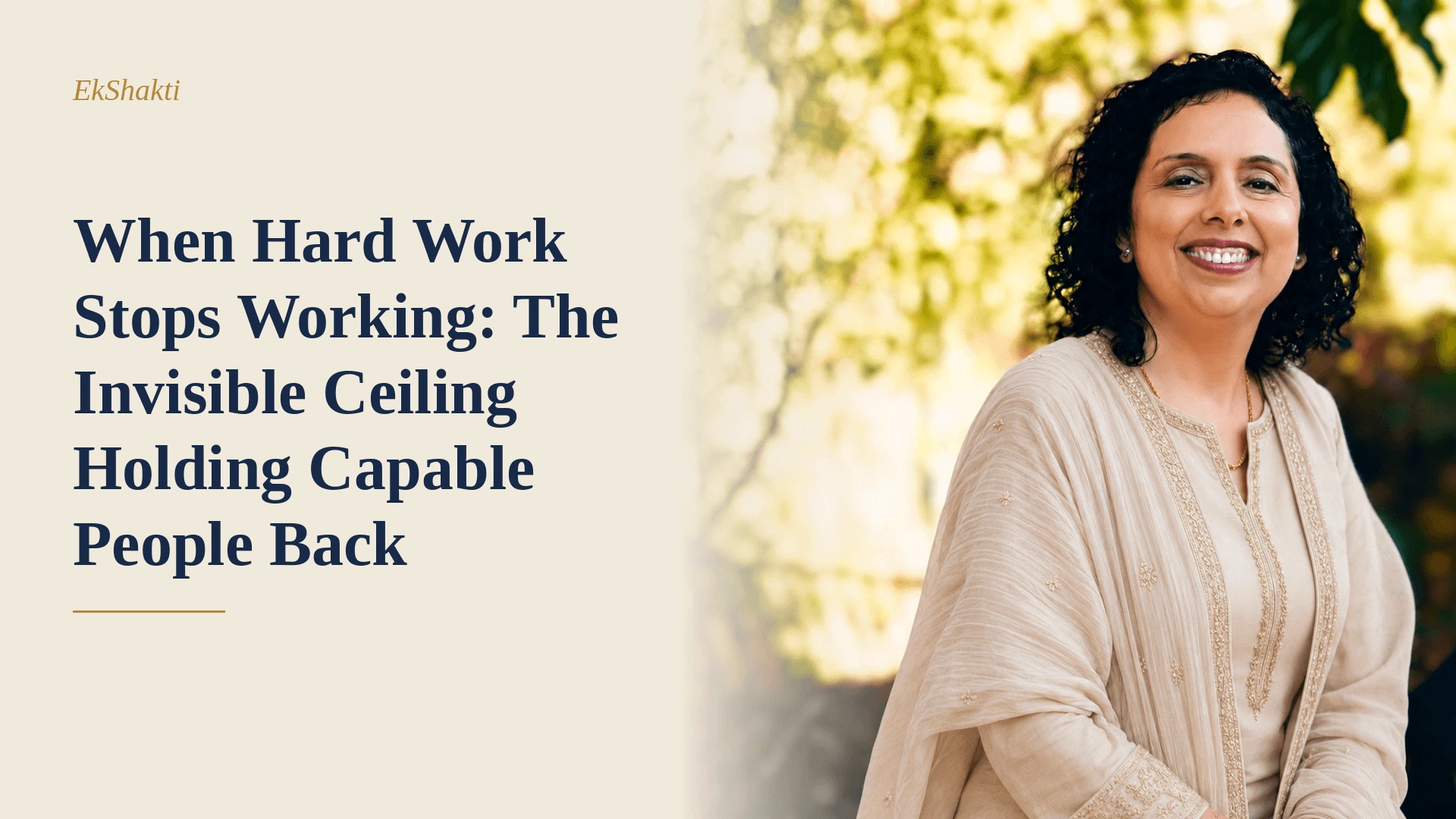
If it doesn’t, and your direction is sound, then the question gets more interesting. If your stall shows up mainly at work, our piece on when hard work stops working looks at the invisible ceiling in more detail.

Chanchala and Akshaya: Two Faces of Lakshmi
During Lakshmi Puja we invite prosperity into the home, and traditions describe Lakshmi in more than one way. One epithet, chanchala, refers to her restless nature: wealth that moves, arrives and departs, never staying long in one place. Another idea, akshaya, refers to that which does not diminish: abundance that stays and grows.
Many people who work hard experience the first and long for the second. Money comes, opportunities come, and then they leave.
Staying Is a Different Skill Than Arriving
It is worth asking honestly: are you struggling to attract, or struggling to hold? These are different problems.
If results arrive and then vanish, the pattern may sit in how you receive, keep or allow what comes, rather than in how much you produce. Working harder to attract more won’t help if what’s coming keeps slipping through.
Chopda Pujan: A Year-End Review Worth Borrowing
In many business families, Diwali is when the old account books are closed and new ones are opened. Chopda Pujan is a literal annual review: what came in, what went out, what to carry forward and what to leave behind.
You can do the same for your own year.
Five Questions for Your Own Ledger
- 1Where did my effort actually go? List the five things that consumed most of your time. Be honest about which ones moved you toward your goal.
- 2What outcome did I expect, and what did I get? Name the gap in plain terms rather than as a feeling.
- 3What repeated? Look for the same setback, the same hesitation, the same kind of conversation.
- 4What am I carrying that isn’t mine? Responsibilities, expectations or beliefs that you took on without choosing them.
- 5What will I not copy into the new book? Choose one habit, belief or commitment to leave behind this year.
This isn’t a prediction about next year. It is a way of making sure you don’t carry the same entries into a fresh page.
Three Things to Do Before You Light the Lamps
You don’t need to overhaul your life this week. A few small, concrete steps are enough.
Clean one corner of your calendar
As you clear the house, clear one commitment from your schedule that is consuming effort without paying you back. Protect that time for the one action that would make the biggest difference to your result.
Name the draft, not just the flame
Write down one pattern that you have seen at least three times, in different settings. Describing it clearly is half of the work. You can’t fix what stays vague.
Choose one action that doesn’t wait for a perfect muhurat
Choosing an auspicious time is a long and valued tradition. But “waiting for the right time” can quietly turn into a reason never to start. If you already know what you want to do, take the smallest possible first step this week.
Where Patterns Like This Actually Heal
Understanding the shape of a pattern is a real first step, but understanding alone rarely shifts it. Change tends to come through guided, sustained work, in a setting where you aren’t alone with it.
Patterns like this heal inside the Akshaya Lakshmi Success Circle, a space built around identifying and working through recurring patterns connected with success and prosperity, alongside others who recognise the same shape in their own lives.
If yours is deeper and personal, you can book a one-on-one consultation, where the work is tailored to your own chart. For a broader introduction to the idea itself, see the Encyclopaedia Britannica overview of karma.
Final Thoughts: Let the Light Land Where It Should
If you’ve been asking why your results don’t match your effort, the most hopeful thing worth knowing is that the answer is probably not that you haven’t tried hard enough. Effort was never the missing ingredient.
Two people, same effort, opposite results. The difference is often something quieter, a pattern operating alongside the work, steering where it goes. That kind of thing can be read. And once it can be read, it can be worked on.
This Diwali, before you light the lamps, look at the draft in the room. Then give your effort a fair chance to burn straight.
Ready to Read Your Own Pattern?
Join the Akshaya Lakshmi Success Circle inside SoulOS and work through the pattern behind your results with Jaya Karamchandani and others who recognise the same shape.
Explore SoulOSFrequently Asked Questions
Results depend on more than effort. Direction, timing, resources, opportunity and recurring personal patterns all influence the outcome. When effort is high and direction is sound but results still lag, it is worth looking at patterns that have repeated across different jobs, relationships or ventures.
Common reasons include effort being spread across the wrong priorities, decisions that repeat the same outcome, difficulty receiving recognition or money, and external circumstances. Reviewing where your time actually goes, and what keeps repeating, is a practical place to start.
Visible outcomes rarely show the full picture. Timing, support, resources and private struggles all play a part. Rather than assuming others have a secret, ask what specific approach you can learn from them and which opportunities you may be overlooking.
A hidden pattern is a recurring way of thinking, behaving or responding that influences your decisions without your full awareness. Look for situations that keep returning in different settings, and note what happens just before they do and how you usually respond.
Karmik numerology reads the numbers associated with a birth date to explore recurring themes around money, responsibility, visibility and receiving. It is used as a reflective framework to understand what keeps repeating, alongside practical planning and professional advice rather than in place of them.
Many people treat Diwali as a natural point for renewal, from cleaning the home to closing old account books and opening new ones. It is a useful moment to review what your effort produced this year and decide what to keep, change or leave behind. The new beginning still depends on the actions you take afterwards.
The Akshaya Lakshmi Success Circle is a space offered by EkShakti for working through recurring patterns connected with success and prosperity. Akshaya refers to that which does not diminish. Details are available through SoulOS.
Jaya Karamchandani offers one-on-one consultations that read the recurring pattern behind a person’s results, so the work can focus on what is actually holding effort back. If yours feels deeper and more personal, you can book a one-on-one consultation.