
Lakshmi Visits Every House. Why Doesn’t She Stay in Yours?
On Diwali evening, something quiet and hopeful happens in homes across the country. Doors are left open. Lamps line the threshold. Rangoli is laid out at the entrance, the floor is swept, and the whole house is prepared for a guest.
The belief behind it is simple and generous: on this night, Lakshmi visits every house.
And yet, anyone who has lived a few Diwalis knows the second half of the sentence. She does not stay in every house.
Some homes seem to hold on to what arrives, year after year. In others, money, opportunity and ease pass through like a guest who stopped only for tea. The same lamps, the same prayers, the same sweets, and very different results.
If you have been privately asking why doesn’t Lakshmi stay in my house, this is not a question about whether you are deserving or devout. It is a question about what kind of house you are keeping, and the answer is often more practical and more personal than the usual advice about where to place a picture or which direction to face.
The Night Every Door Is Open
Diwali, as described in Britannica’s overview of the festival, is one of the few festivals built around the idea of welcoming. We clean, repaint, repair and decorate. We light diyas to mark a path, and we keep the entrance open and bright.
What the Rituals Are Really Saying
Look closely at what we do before Lakshmi Puja:
- 1We clear clutter and wipe away dust.
- 2We repair what is broken.
- 3We light lamps so that nothing sits in the dark.
- 4We settle old arguments, or at least try to be gracious for the evening.
- 5We make the doorway beautiful and unblocked.
None of this is random. Strip away the details, and the message is about order, light, harmony and readiness to receive. The ritual isn’t only asking Lakshmi to visit. It is quietly asking whether the house is ready for her.
Why Doesn’t Lakshmi Stay in My House? Arriving Is Not the Same as Staying
It helps to separate two experiences that are often lumped together.
Arriving is when money, a job offer, a client or an opportunity shows up. Staying is whether any of it remains: whether income turns into savings, whether a good year builds into a better one, whether a win becomes a foundation.
Signs That Wealth Is Visiting Rather Than Living With You
- 1A good month ends with nothing to show for it.
- 2Bonuses and windfalls seem to disappear within weeks.
- 3Opportunities arrive, reach a late stage and then fade.
- 4You earn well but never feel financially settled.
- 5Every time savings build, an unexpected expense arrives.
If this sounds familiar, the instinctive response is to work harder or to attract more. But if arrival isn’t the problem, doing more of the arriving won’t solve anything. The more useful question is what happens after she walks in.
What Traditions Say About Where She Stays
Lakshmi appears in many stories, and one theme repeats across them: she is drawn to certain conditions and leaves others. In the well-known tale of the churning of the ocean, she is said to have left the gods after a moment of arrogance and disrespect, and returned only when the world turned its attention to effort, patience and balance.
You don’t have to read these stories literally to see what they are pointing at. Households and traditions have long linked her presence with a handful of qualities.
Order, Light and Harmony
Order
A house, a routine and a set of finances that are kept in good repair.
Light
Honesty and clarity, with nothing important hidden or avoided.
Harmony
Relationships that are not constantly at war, and gratitude for what already exists.
These are ordinary, practical things, and that is the point. Lakshmi is often described as chanchala, restless and quick to move on. The traditional answer to a restless guest is not force. It is a home in which staying feels natural.
How to Make Lakshmi Stay at Home: Beyond the Cleaning
Most advice on how to make Lakshmi stay at home stays on the outside: what to buy, where to keep it, how to arrange the entrance. Those traditions matter to many people, and there is nothing wrong with honouring them.
But if you have done all of it and the pattern persists, it may be worth looking at a second house: the one inside you.
The House Within
Every person carries habits, beliefs and expectations about money, worth and security. They shape how we earn, spend, give and keep, and most of them were set long before we could examine them. Think of them as rooms.
The Room of Receiving
Can you accept money, praise or help without immediately redirecting it, apologising for it or giving it away?
The Room of Scarcity
Does some part of you assume that good things don’t last, so you spend them before they can leave?
The Room of Giving
Do you take care of everyone else’s needs first, leaving very little for yourself?
The Room of Old Arguments
Are there unresolved conflicts, obligations or silences that quietly drain energy and attention?
The Room of Avoidance
Are there financial decisions, conversations or tasks you have been postponing?
A house can be spotless and still have a locked room in it. That is why some people clean thoroughly every Diwali and still see the same results.
Why Money Doesn’t Stay in Hand: The Pattern Behind the Leak
When the same thing happens repeatedly, in different jobs, cities and even income levels, it stops looking like bad luck and starts looking like a pattern. Why money doesn’t stay in hand is rarely about one big decision. It is more often a quiet, consistent habit that nobody can quite name.
Common Patterns Behind a Leaking Month
- 1Giving more than you can comfortably afford, as a way of feeling worthy.
- 2Spending soon after receiving, to relieve an unconscious unease about holding a lot.
- 3Undercharging or underasking, so that income never reaches its natural level.
- 4Taking on other people’s financial burdens without a clear boundary.
- 5Inheriting a quiet belief, from family, that money is heavy or comes at a cost.
These patterns are rarely chosen. Many are absorbed early from the people around us, and they feel like personality rather than pattern. That is precisely what makes them hard to see from the inside — a point echoed in Psychology Today’s coverage of money and behaviour.
Karmik Numerology and Wealth: Reading the Inner House
This is where karmik numerology and wealth meet practically. Karmik numerology reads the numbers connected with your birth date as a map of recurring themes: how you tend to handle money, responsibility, visibility, receiving and security. It is a reflective framework, not a promise of any particular outcome, and it works best alongside practical planning and professional advice.
The central question it asks is not “what will happen to me?” It is “what keeps happening, and where does it begin?”
Why Naming the Pattern Matters
Guessing at your pattern usually produces the wrong story. It is easy to blame the economy, a partner, a boss or your own character. A structured reading gives you something more specific to work with, and a specific pattern is far easier to change than a general feeling of never having enough. You can begin exploring your own numbers with the free numerology calculator.
At EkShakti, this is the layer Jaya Karamchandani works with: reading the recurring pattern behind a person’s financial experience, rather than treating each month’s shortfall as a separate event.
A Diwali Checklist for the Inner House
Before you light the lamps this year, take twenty minutes with a notebook and walk through your inner house.
The Doorway: Can I Receive?
Think of the last time money, credit or help came to you easily. What did you do with it in the first week? Notice whether your first instinct is to keep, share, spend or deflect.
The Rooms: What Is Cluttered?
Name one financial or personal matter you have been avoiding — a statement you haven’t opened, a conversation you keep postponing, or a commitment you have outgrown. Choose one and take the smallest possible step on it before Diwali.
The Lamp: What Do I Keep Lit?
Which habit do you want to be the steady flame in the year ahead? A savings routine, a regular review of accounts, a daily practice of gratitude. Choose one and make it small enough to keep.
The Guests: Who and What Do I Allow to Stay?
Look at the demands on your time, money and energy. Are there obligations you carry that are not yours? This isn’t about becoming less generous — it is about being generous on purpose, rather than by default.
Chopda Pujan: Closing the Old Book
In many business families, Diwali is when old account books are closed and new ones opened, a ritual known as Chopda Pujan. It is a literal annual review of what came in, what went out and what to carry forward.
“Write down the three patterns that repeated most in your year. Then decide which entries you won’t copy into the new book.”
— A personal Chopda Pujan, from EkShaktiThis is not about predicting next year’s results. It is about making sure that you don’t write the same page twice.
Where Patterns Like This Actually Heal
Understanding a pattern is a real first step, but understanding alone rarely shifts it. Change tends to come through guided, sustained work, in a setting where you aren’t alone with it.
Patterns like this heal inside the Akshaya Lakshmi Success Circle, a space built around identifying and working through recurring patterns connected with wealth, success and prosperity, alongside others who recognise the same shape in their own lives. Akshaya means that which does not diminish, which is a fitting intention for any home that wants wealth to stay.
If yours is deeper and personal, you can book a one-on-one consultation, where the work is tailored to your own chart. Explore both here: SoulOS.
Final Thoughts: Make Room for the Guest
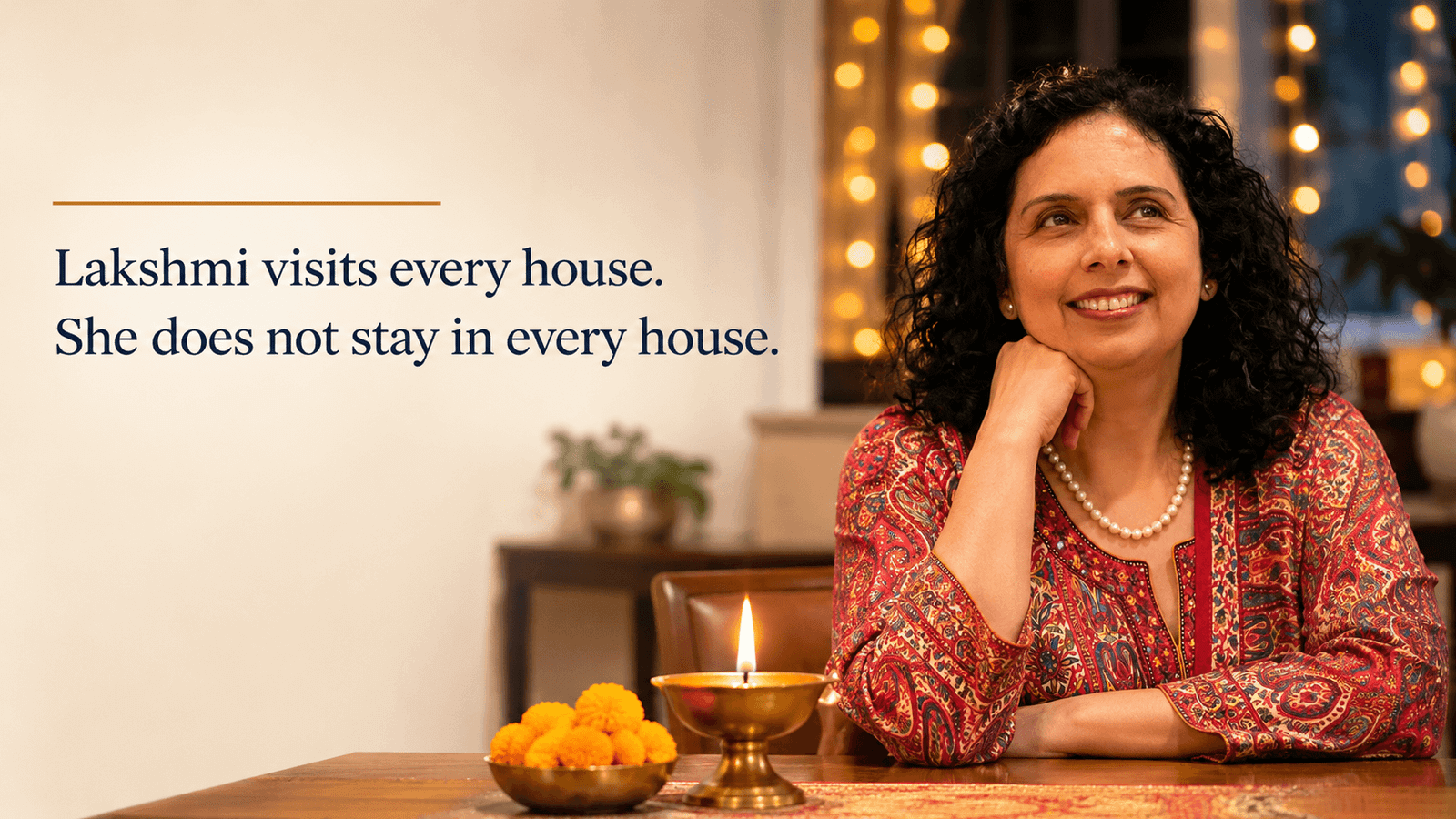
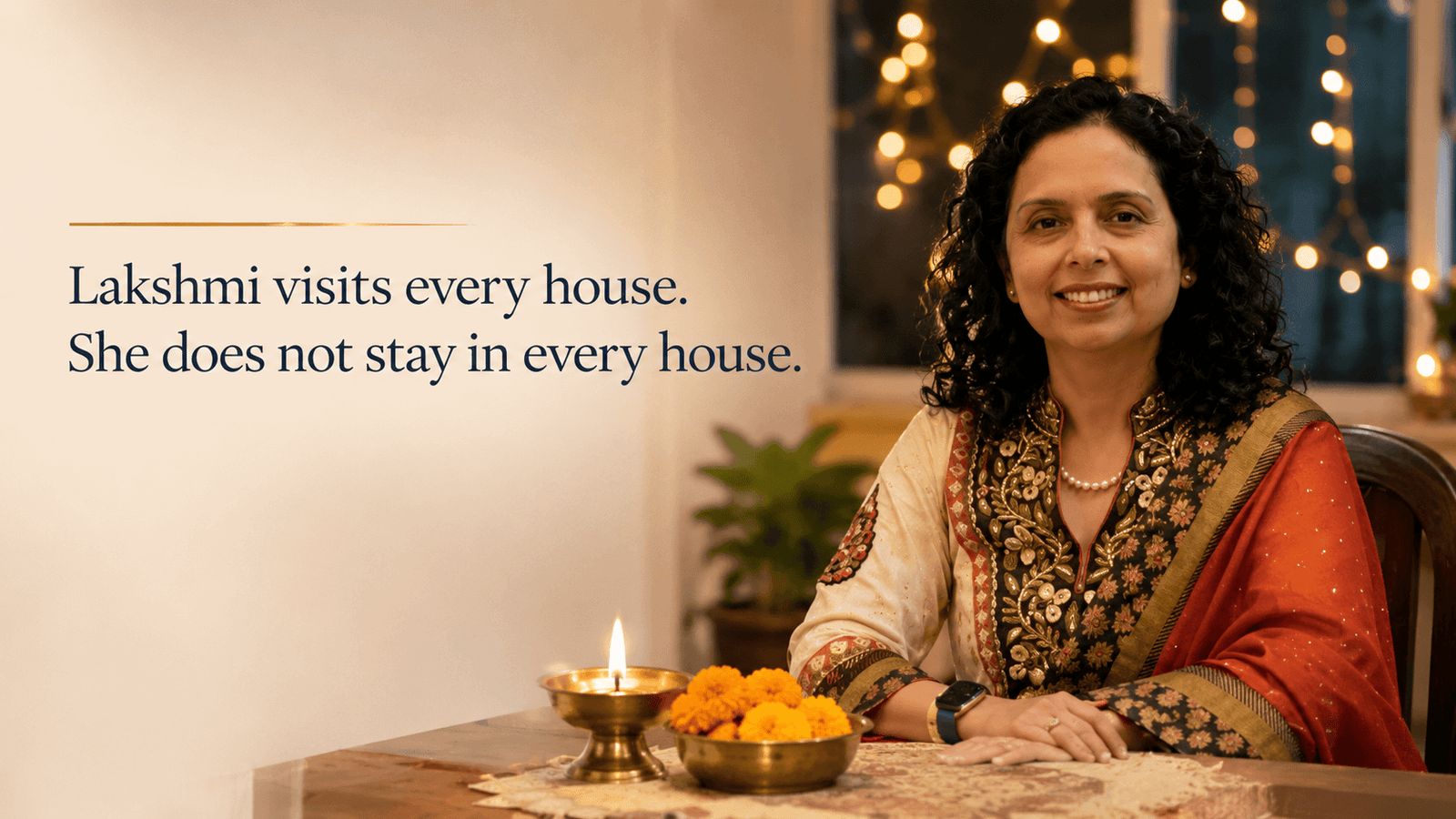
Lakshmi visits every house. She does not stay in every house.
That sentence can be heard as a closed door, a sign that some people are simply favoured and others are not. A more useful way to hear it is as an invitation. If staying depends on how a house is kept, then there is something you can examine, adjust and tend, both on the outside and within.
This Diwali, light the lamps, open the door and sweep the entrance. But also ask what is waiting in the rooms behind it. A guest is far more likely to stay in a home that is ready for her.
Ready to Make Room for the Guest?
A personal reading with Jaya Karamchandani can map the recurring pattern behind why wealth leaves — so the work can focus on what is actually causing it.
Frequently Asked Questions
In traditional belief, Lakshmi is associated with order, light, harmony and gratitude. If wealth arrives but doesn’t stay, it may be worth looking at habits, beliefs and unresolved patterns around money, as well as the physical state of the home. Practical financial planning matters equally.
Many households keep the home clean, bright and orderly, maintain harmony and observe Lakshmi Puja on Diwali. Beyond these traditions, it helps to examine how you receive, save and spend money, and whether repeated patterns are causing wealth to leave soon after it arrives.
Lakshmi Puja is performed on Diwali to welcome prosperity, health and good fortune into the home. Cleaning the house, lighting diyas and opening the doors express readiness to receive, along with gratitude for what already exists.
When income doesn’t turn into savings or stability, it is often linked to repeated habits, such as over-giving, spending soon after receiving, undercharging or inherited beliefs about money. Identifying the specific pattern is usually more useful than simply trying to earn more.
Karmik numerology reads the numbers associated with a birth date to explore recurring themes around money, responsibility and receiving. It is a reflective framework for understanding patterns, and it should be used alongside practical planning and professional advice rather than as a guarantee of any outcome.
Chopda Pujan is the Diwali ritual in which business families close old account books and open new ones. It is a symbolic annual review, and many people adapt the idea to review their own year, recognising what repeated and what they want to leave behind.
The Akshaya Lakshmi Success Circle is a space offered by EkShakti for working through recurring patterns connected with wealth, success and prosperity. Akshaya means that which does not diminish. Details are available at the SoulOS page.
Jaya Karamchandani offers one-on-one consultations that read the recurring pattern behind a person’s financial experience, so the work can focus on what is actually causing wealth to leave. If yours is deeper and personal, you can book a one-on-one consultation with her.