
There are roughly six weeks left in the year.
That is a surprisingly short time, and a surprisingly long one. Short enough that it will vanish into year-end deadlines, family plans and festive calendars. Long enough to change what January feels like.
Because January arrives whether you are ready for it or not. What decides whether it feels like a fresh page or like the same one, carried over, is rarely a resolution made on the first. It is what you did, or didn’t do, in the weeks before.
If you have been wondering how to start the new year fresh, this piece is about the part nobody puts in the New Year’s Eve post: the six weeks of quiet work that come first.
Most of us don’t actually begin a new year. We continue the old one, and give it a new number.
— EkShaktiThe Calendar Turns. You Don’t Automatically.
On 1 January the date changes. Almost nothing else does. The same job is waiting, the same relationships, the same unanswered message, the same decision you were already thinking about at this time last year.
What Travels With You Into January
- 1A decision you’ve put off making “after the holidays” for the second or third year running.
- 2A conversation you have rehearsed more often than you have had it.
- 3A financial matter you haven’t looked at directly, such as a review, a payment or a plan.
- 4A project that is neither finished nor formally dropped, still occupying space in your head.
- 5A grievance or obligation you carry out of habit.
None of this is a failure. It is simply what an open item does when it is left open. It travels.
Why January Feels Like the Same Year
It is common to feel, a few days into January, that nothing has really changed, despite the new planner and the good intentions. This sense that January feels like the same year has an ordinary explanation.
Unfinished Things Stay Loud
Many people notice, and psychologists have described, that unfinished tasks tend to linger in the mind more stubbornly than finished ones. This is often called the Zeigarnik effect. Open items sit in the background and take small, constant amounts of attention. A mind carrying a dozen of them has less room for something new, however motivated it feels.
That is why the new year can feel heavy right from the start. The fresh page is blank, but you are still carrying the contents of the last one.
Why Resolutions Often Don’t Fix It
A resolution adds a new goal on top of the old pile. It doesn’t remove anything. If you are already at capacity with unresolved items, a fresh ambition can add pressure rather than relief, and it often fades for exactly that reason.
The Six-Week Window: Why Now Matters
If the aim is to end the year well, the most useful time to begin is not December 31st. It is now.
Six weeks is realistic for closing a small number of important things. It isn’t realistic for closing everything, and it was never meant to be. The final fortnight of the year is also usually crowded, so the real working window is closer to four weeks.
That is a good constraint. It forces a choice about what matters most.
A Simple Six-Week Plan
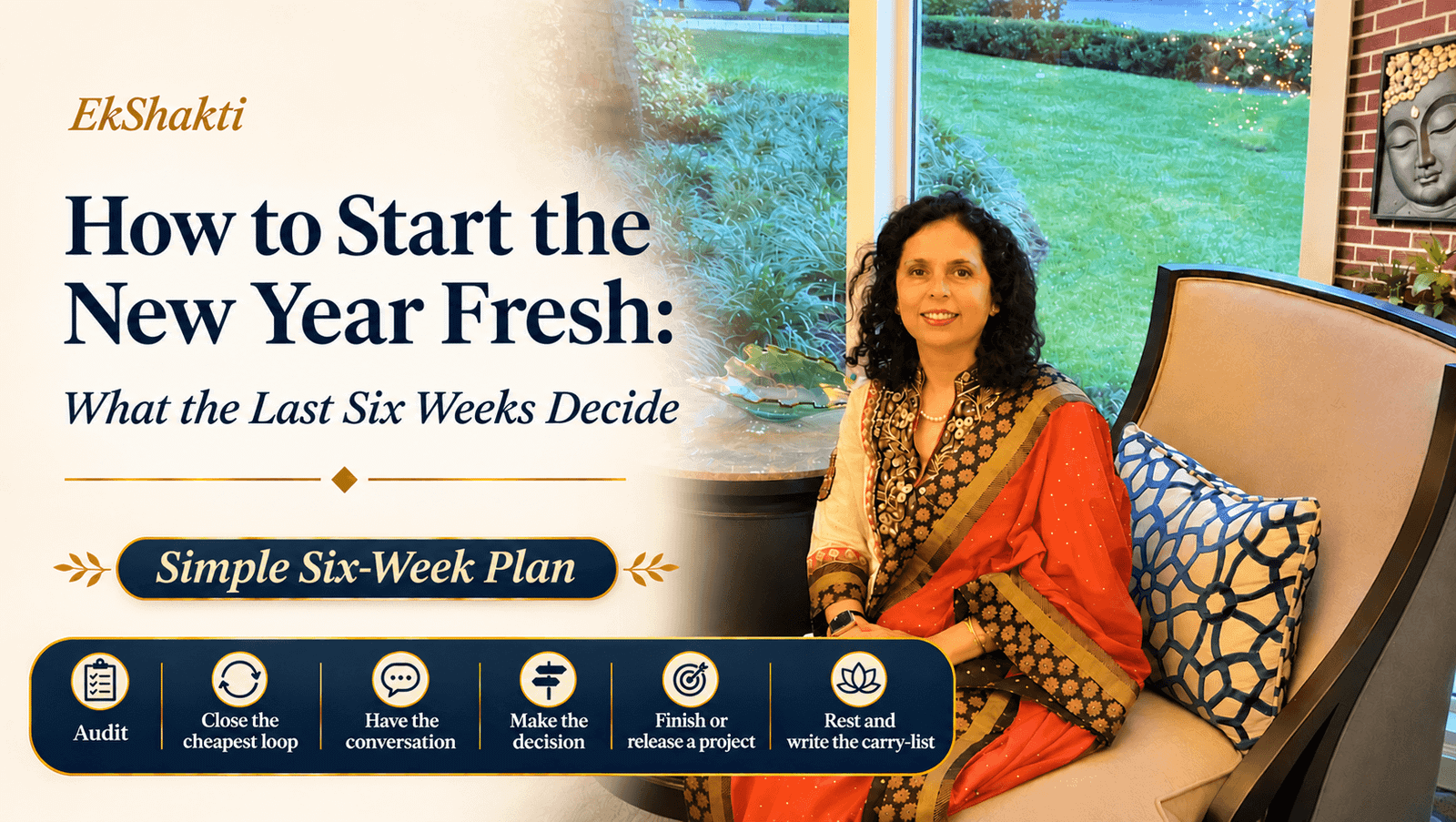
Week 1: Audit
Write down every open item you can think of. Don’t edit. Then circle the three that weigh on you most.
Week 2: Close the cheapest loop
Pick the item that would take the least effort to finish, and finish it. The relief is useful momentum.
Week 3: Have the conversation
Choose the discussion you’ve been avoiding, and schedule it. Imperfect and done beats perfect and postponed.
Week 4: Make the decision
Take one decision that has been hanging and set a date. If it is genuinely too big, decide the next small step.
Week 5: Finish or release a project
Complete it, or consciously let it go. Stopping on purpose is different from abandoning it by drift.
Week 6: Rest and write the carry-list
Write down what you are choosing to take into January, and what you are leaving behind. Then rest.
Three Ways to Close a Loop
Closing something doesn’t always mean completing it. There are three honest ways to end an open item.
Finish, Decide or Release
- 1Finish it: do the thing. This suits tasks that are within reach.
- 2Decide it: make the call, even if the outcome isn’t certain. A decision with a date is a closed loop.
- 3Release it: formally let it go. Tell yourself, and anyone involved, that you are no longer carrying it.
The third option is the most underused. Many of the heaviest things we carry are not tasks to complete, but commitments we have outgrown and haven’t had permission to put down.
Trending: Why “Fresh Start” Dates Pull Us In
Researchers have a name for the urge to begin again on a new date: the fresh start effect. A study by Dai, Milkman and Riis, published in Management Science, found that people are more likely to pursue goals after temporal landmarks such as a new year, a new month or a birthday.
The landmark gives you the motivation. It doesn’t give you the space. That is exactly why the weeks before 1 January 2027 matter: clear the old page now, and the new date has somewhere to land.
Karmik Numerology and What You Tend to Carry Over
This is where karmik numerology for the new year offers a useful lens. It starts from a pattern many people recognise once it is named: we don’t carry random things into each new year. Each of us tends to carry the same kind of thing.
Karmik numerology reads the numbers connected with your birth date as a map of recurring tendencies. Your Mulank, the number of the day you were born on, is a simple place to start. Add the digits of your birth day until you reach a single digit. Someone born on the 25th, for example, adds 2 + 5 to get 7.
What Each Number Tends to Carry Forward
- 1A decision made alone that never got tested with anyone else.
- 2A conversation postponed to keep the peace.
- 3Too many projects opened, and none closed.
- 4A plan waiting for a guarantee that never arrives.
- 5An option kept open long after you’ve outgrown it.
- 6A family obligation carried without having had a say in it.
- 7A question researched thoroughly and never answered.
- 8A financial matter put off because it feels heavy.
- 9A loyalty or burden kept far past its time.
This is a starting point, not a full reading. If one line lands uncomfortably close, treat it gently. It is a sign of something you have been carrying out of habit, not a flaw.
Why Naming the Carry-Over Helps
At EkShakti, this is the layer Jaya Karamchandani works with: reading the recurring pattern behind what a person keeps carrying, rather than only listing what is on their to-do list. Once the pattern has a name, it tends to stop quietly running decisions in the background.
Karmik numerology is a reflective framework. It works best alongside practical planning and, where relevant, professional advice, and it does not promise any particular outcome.
Personal Year Numerology: What Kind of Page Is Next?
Not every new year asks the same thing of you. This is the idea behind personal year numerology, which treats life as moving through repeating cycles, with each year carrying a different emphasis.
Finding Your Personal Year
A common method is to add your birth day, your birth month and the digits of the year, then reduce the total to a single digit. For example, someone born on 6 July, looking ahead to 2027, would calculate 6 + 7 + 2 + 0 + 2 + 7 = 24, which reduces to 6. In many readings, a 6 year is associated with home, relationships and responsibility. The EkShakti numerology calculator can help you start.
Methods vary between traditions, so treat this as a starting point rather than a verdict.
Why This Helps You Close the Right Things
Some years are described as favouring beginnings, others as favouring building, clearing, tending or completing. Knowing roughly what kind of page is coming can help you decide what to close now. If the next year emphasises relationships and responsibility, an unresolved family conversation is probably worth finishing before January. If it emphasises new ventures, an abandoned project may be worth releasing to make room.
It is a guide to where to look, not a reason to wait or to explain away setbacks.
Newness Comes From Endings, Not Dates
It is worth saying plainly. A date can’t give you a fresh start. A new planner can’t either. What gives a new year its feeling of lightness is the experience of having closed something.
People who have done this describe it quite consistently. They say that January felt different, not because anything dramatic happened, but because there was less in the background. The mind had room.
A Small Test for Yourself
On the last day of the year, ask: if January began tomorrow, what would I still be thinking about from this year? Whatever comes to mind first is probably your most important open loop, and the one worth closing while there is still time.
Where Patterns Like This Actually Heal
Closing a loop is a practical skill. But if the same kinds of items keep following you from year to year, that is usually a pattern rather than a scheduling problem, and understanding alone rarely shifts it. Change tends to come through guided, sustained work, in a setting where you aren’t alone with it.
Patterns like this heal inside the Akshaya Lakshmi Success Circle, a space built around identifying and working through recurring patterns connected with success and prosperity, alongside others who recognise the same shape in their own lives. Akshaya means that which does not diminish, which is a fitting intention for a year you want to begin lightly.
If yours is deeper and personal, you can book a one-on-one consultation, where the work is tailored to your own chart.
Final Thoughts: Choose Your Page Now
January will arrive on schedule. Whether it feels like a fresh page or the same one carried over is decided much earlier, in the ordinary days between now and the end of the year.
You don’t have to close everything. You need to close a few important things, honestly and on purpose, and decide what you are leaving behind.
If you have been asking how to start the new year fresh, begin today. Pick one open loop and choose whether to finish it, decide it or release it. Six weeks is enough for that, and the page ahead will feel noticeably different for it.
Ready to Begin 2027 Lighter?
Join the Akshaya Lakshmi Success Circle inside SoulOS and work through the pattern behind what you keep carrying, with Jaya Karamchandani and others who recognise the same shape.
Explore SoulOSFrequently Asked Questions
A fresh start comes less from the date and more from what you close beforehand. Use the weeks before the year ends to finish, decide or release the open items you would otherwise carry into January, so that the new year begins with more space and less background weight.
Because most of what occupied you in December is still unresolved. Unfinished decisions, conversations and commitments travel into the new year, and unfinished tasks tend to linger in the mind more than finished ones. A new calendar doesn’t remove them.
Focus on a small number of important items rather than everything. Audit your open loops, close the easiest one, have the avoided conversation, make one decision and either finish or release one project. The last six weeks are enough for this.
Closing an open loop means finishing the task, making the decision or consciously releasing the commitment. Releasing is often the most overlooked option, and it can be as effective as completing something.
A personal year is a number, usually calculated from your birth day, birth month and the year reduced to a single digit, which numerology uses to describe the emphasis of that year in a repeating cycle. Methods differ between traditions, so it is best used as a reflective guide.
Karmik numerology reads numbers associated with a birth date to explore recurring tendencies, including what a person tends to carry from one year to the next. It is a reflective framework that works best alongside practical planning and does not guarantee any outcome.
A resolution adds a new goal on top of existing unresolved items. If you are already at capacity, the new ambition can add pressure and fade quickly. Closing a few open items first often gives a resolution more room to hold.
Jaya Karamchandani offers consultations that read the recurring pattern behind what a person keeps carrying from year to year. Patterns like this heal inside the Akshaya Lakshmi Success Circle, and if yours is deeper and personal, you can book a one-on-one consultation.