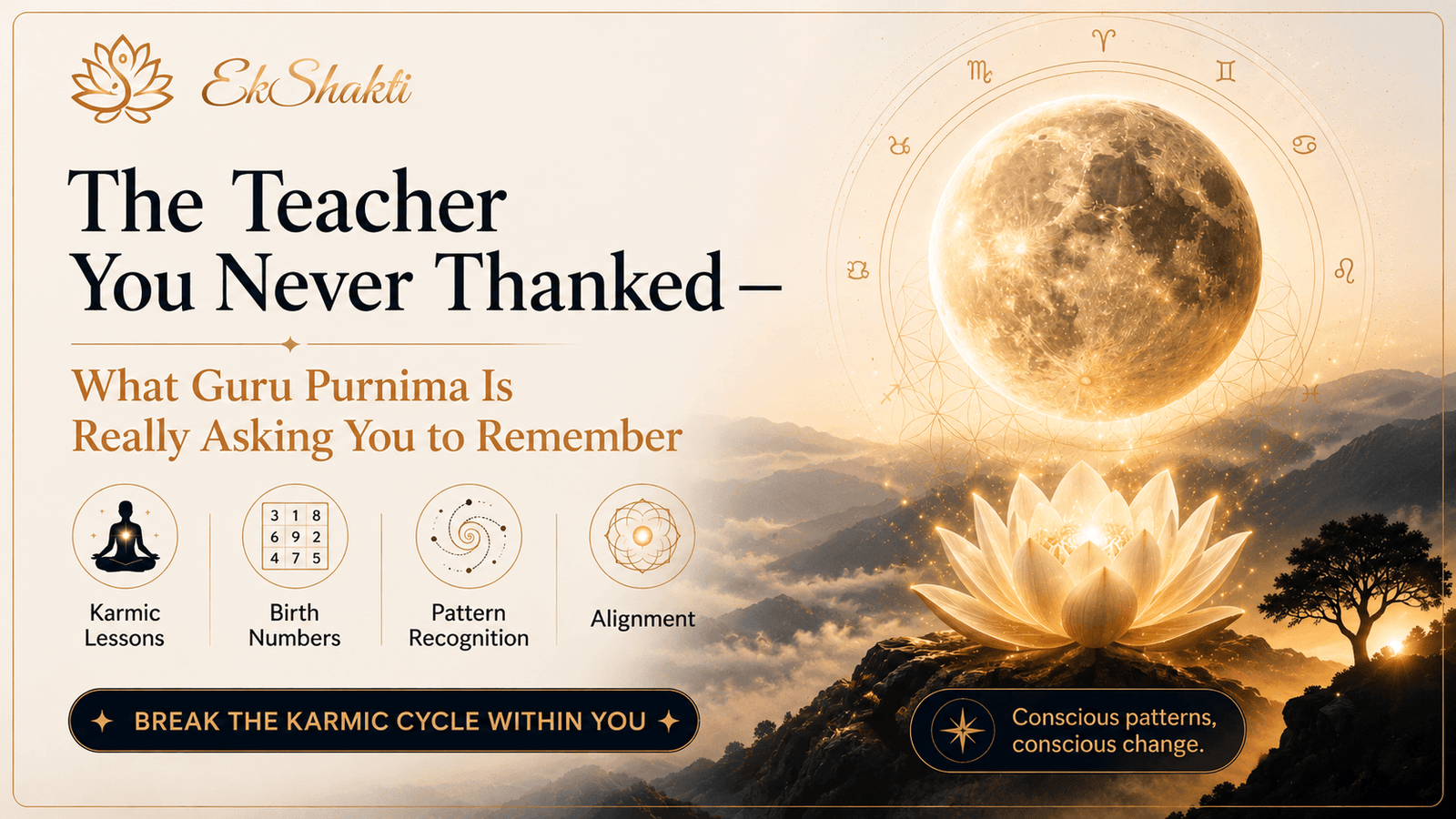

There’s a name that comes to mind on days like this. You might not have thought about them in years. Maybe it’s someone who said one thing, at one moment, that quietly changed the direction of everything that came after. Maybe it’s someone who hurt you in a way you didn’t understand until much later, and then — only in hindsight — realized had also taught you something you couldn’t have learned any other way.
Guru Purnima has a way of surfacing these people. Not loudly. Not with ceremony. Just — quietly, the way a memory does when you’re not trying to call it up.
Most of us mark this day with some awareness of its spiritual significance. Full moon of Ashadha. Day dedicated to Maharishi Ved Vyasa. A day to honor those who guided us. And we do honor them — our parents, our mentors, the teacher in school who noticed something in us before we noticed it ourselves.
But Guru Purnima, when you sit with it long enough, is asking something a little harder than that.
The Gratitude We’re Comfortable With — And the Kind We Avoid
It’s easy to feel grateful for the people who were gentle with us. The ones who held space, who encouraged, who showed up in the ways we’d hoped someone would.
What’s harder is acknowledging the ones who weren’t gentle — and who, despite that, were also teaching.
The employer who made you feel small, and forced you to learn exactly how much you were actually worth. The relationship that broke apart in a way you didn’t choose, and in doing so, broke open something in you that needed to be broken. The season of life that felt like pure failure — the closed doors, the financial strain, the year you don’t really talk about at dinner — that turned out to be the period in which you became the person you actually are.
“A Guru is anyone — any experience, any person, any difficult passage — that dispels the darkness you were living in, whether or not they arrived kindly.”
— On the Vedic root of the word Guru: gu (darkness), ru (the one who removes it)Vedic tradition, as explored in Britannica’s overview of the guru tradition, has always understood this. On Guru Purnima, the question most people ask is: who helped me rise? The deeper question — the one that actually moves something — is: what taught me, that I never acknowledged as teaching?
What Repeating Patterns Have to Do With Guru Purnima
Here’s something that doesn’t often get connected to this day, but should.
Many people carry a pattern they can’t quite name — a recurring experience of effort not translating into what it should. In career, in relationships, in the milestones that keep arriving for everyone around them and somehow not for them, despite equal or greater work.
They try different strategies. Change jobs. Start over in a new city. Approach relationships differently. And the same invisible ceiling follows them.
In karmik numerology, this isn’t random and it isn’t personal failure. It’s the signature of an unresolved karmik lesson — one written into the birth chart long before the person was old enough to understand it was there.
And Guru Purnima, of all days, is when this becomes relevant — because a karmik pattern, at its root, is also a teacher. One of the most persistent and patient teachers there is.
The pattern doesn’t stop until the lesson is seen. That’s not punishment. That’s just how learning works.
What karmik Numerology Actually Reads
When someone comes to Jaya Karamchandani at EkShakti feeling stuck — in a career that won’t move forward, in relationships that keep circling the same disconnection, in a life that looks like it should be working but somehow isn’t — the first thing a karmik numerology reading does is stop the guessing.
Most people in this situation have already tried the obvious fixes. They’ve worked harder. Asked for feedback. Been patient. Started fresh. And the pattern still returns — not because they’re doing anything wrong, but because the root of it was never visible in the first place.
A karmik numerology reading maps the specific structure behind a stuck pattern. Not in vague, general terms — but specifically: which number in the birth chart is creating resistance, in which area of life, connected to what kind of recurring experience.
This is the difference between telling someone to “trust the process” and actually showing them what the process is.
The Life Path Number and What It Reveals About How You Learn
Your Life Path Number — derived from your complete date of birth — is one of the first places a karmik reading looks. It indicates not just your personality style, but the specific kind of experience through which you are designed to grow.
Example: Life Path 4
A person with a Life Path 4 will often encounter lessons through structure, discipline, and the slow frustration of building things that don’t seem to pay off when they should.
- Not because they’re doing it wrong
- Their path requires a particular relationship with patience and foundation
- Other life paths don’t need to develop this same relationship in the same way
Understanding this doesn’t remove the frustration. But it completely changes what the frustration means — and what to actually do about it.
karmik Debt Numbers and Why the Same Lesson Keeps Returning
Some birth charts carry what are called karmik Debt Numbers — 13, 14, 16, and 19. These are specific numerical patterns that indicate a soul-level lesson either unresolved from a previous life cycle or carrying particular intensity in the current one.
13
Often tied to lessons around consistent effort, discipline, and follow-through.
14
Often tied to lessons around freedom, restraint, and moderation.
16
Often tied to lessons around ego, humility, and letting go of old identities.
19
Often tied to lessons around independence and learning to rely on others.
If you have noticed that a very specific kind of difficulty keeps repeating — the same kind of relationship ending in the same way, the same kind of professional recognition arriving for everyone but you, the same kind of setback appearing in different forms across different contexts — a karmik Debt Number is often the structural explanation.
This isn’t a curse. It’s not something to be afraid of. It is, in the truest sense, a teacher — the same teacher arriving again and again in different costumes until the lesson it carries is finally understood.
Personal Year Numbers and Why Timing Matters More Than Effort
This is perhaps the most practically useful thing karmik numerology offers: the understanding that not every year is designed for the same kind of progress.
Your Personal Year Number shifts annually based on your birth date and the current calendar year. Some years are built for planting — for laying groundwork that won’t visibly pay off yet. Some are built for harvest — when effort from previous years suddenly converts into visible results. Some are years of integration, of endings, of necessary clearing before a new cycle begins.
When someone is in a planting year and pressing hard for harvest results, the experience is of running and getting nowhere — not because the effort is wrong, but because the timing hasn’t yet caught up with it. This is one of the most common explanations for why hard work stops paying off in a specific season — not a karmik block at all, but a misunderstanding of where you actually are in your cycle.
Knowing your Personal Year Number doesn’t take effort out of the equation. It simply tells you where to point it.
The Guru Purnima Invitation, Specifically
2026 is a Universal Year 1 in numerology — 2+0+2+6 = 10, which reduces to 1. A Year 1 is a collective reset. It carries the energy of initiation, of new chapters beginning, of old patterns finally releasing their grip.
When Guru Purnima falls within a Universal Year 1, the teachings that arrive carry a particular quality. They’re not maintenance lessons — they’re initiatory ones. The kind that mark a before and after in how you understand yourself.
If something has been stuck — in your career, in a relationship, in a major decision you keep circling but not landing — this full moon in a Year 1 is one of the more precise windows to actually look at it directly, rather than waiting for it to resolve on its own.
Not because the full moon is magic. But because these cycles, when you understand them numerologically, create windows of unusual clarity — and clarity, more than effort, is usually what actually moves a pattern forward.
Three Things Worth Doing on This Day
Not rituals for ritual’s sake. Just three things that are actually useful.

Name the teacher you’ve been avoiding thanking
Not the gentle ones — you’ve already thanked them. The difficult one. The experience you’ve never quite made peace with. You don’t have to make peace with it today. Just acknowledge that it taught you something, even if you’re still deciding what.
Look at the pattern, not just the problem
If something in your life has felt stuck — not once, but repeatedly — spend some time with the shape of it rather than just the frustration of it. Is it always the same stage at which things stall? The same kind of person involved? The shape of a pattern is usually more informative than the content.
Consider whether you need a clearer outside view
There’s a particular kind of stuck that comes from trying to navigate a pattern you can’t fully see because you’re inside it. A teacher — whether a person, a reading, or a piece of information that reframes everything — sometimes offers more movement in one conversation than months of effort in the same direction.
This is also the thinking behind SoulOS, EkShakti’s structured system for identifying exactly this kind of recurring karmik pattern — built so the outside view isn’t vague encouragement, but a specific, readable structure.
When You’re Ready to Actually See What’s Blocking You
The work Jaya Karamchandani does at EkShakti is, at its foundation, exactly this — taking the pattern that’s been repeating quietly in someone’s life and mapping it against their specific numerological chart to show where the resistance actually lives.
Not in vague terms. Not in generic encouragement. In the specific language of numbers, cycles, and karmik structure that makes it possible to say: this is the pattern, this is where it lives in your chart, and this is what working with it — rather than against it — actually looks like.
If you’ve been in that 2 AM place — doing the math on why effort isn’t translating, wondering if you’re missing something everyone else seems to understand — this is the kind of reading that replaces that question with an actual answer.
It won’t tell you your future. That’s not what this is. What it will do is show you your pattern clearly enough that the future stops feeling like something happening to you and starts feeling like something you can actually navigate. You can also start with the free numerology calculator to explore your own core numbers first.
The Moon Will Wane by Morning
The full moon of Guru Purnima doesn’t stay full. By morning it will have already begun its quiet recession. What it illuminated, though — the name that surfaced, the pattern you paused on, the question you’re not quite sure how to ask yet — that doesn’t have to fade with it.
“Guru Purnima doesn’t demand action. It asks, simply, that you look honestly — at who taught you, at what’s still teaching you, and at whether you’re ready to finally understand the lesson well enough to move past it.”
— Jaya Karamchandani, EkShaktiThe light was always there. Sometimes the most useful thing is simply someone who can help you see it. For broader context on the day itself, Britannica’s entry on Maharishi Ved Vyasa offers useful background — though a personalised numerology reading will always reveal what a general history cannot.
Ready to See the Pattern That’s Been Teaching You?
A personal karmik numerology reading with Jaya Karamchandani can show exactly where your pattern lives in your chart — and what working with it, instead of against it, actually looks like.
Frequently Asked Questions
Guru Purnima is observed on the full moon day of the Hindu month of Ashadha and is dedicated to honoring teachers, guides, and wisdom figures who have shaped a person’s life and path. Rooted in the tradition of Maharishi Ved Vyasa, the day has expanded across centuries to include any person or experience that has dispelled darkness and brought clarity — the literal meaning of the word Guru.
In karmik tradition, the experiences and people that repeat most persistently in a person’s life are understood to be teachers in their own right — carrying lessons the soul is still in the process of learning. Guru Purnima is a natural moment to acknowledge these patterns honestly, which is often the first step to actually moving through them.
A karmik pattern in numerology refers to a recurring structure of experience — often connected to specific numbers in a person’s birth chart — that creates consistent resistance in a particular area of life, regardless of how much effort is applied there. Common examples include consistent career stagnation despite strong performance, relationships that repeatedly stall at the same stage, or major life decisions that keep meeting the same unexpected obstacle.
karmik Debt Numbers — 13, 14, 16, and 19 — appear in a numerology chart when specific calculations produce these values. They indicate soul-level lessons that carry particular intensity in the current life cycle. Having one isn’t something to be afraid of. It’s information — the same way a map shows difficult terrain not to discourage the journey, but to help you navigate it.
Your Personal Year Number is calculated from your birth date and the current calendar year, and it shifts annually. Each year carries a different energy — some years are designed for building and planting, others for harvesting results, others for clearing and transition. Understanding your Personal Year Number can explain why certain periods feel like progress stalls even when effort is high — and where effort is most likely to actually convert into visible results.
When a very specific difficulty — the same kind of stalling, the same kind of being overlooked, the same kind of opportunity that almost materializes and then doesn’t — repeats across different jobs, relationships, or life contexts, it typically points to a karmik pattern rather than coincidence. The setting changes, but the underlying structure stays the same until it’s identified and worked with directly.
Guru Purnima in a Universal Year 1 (which 2026 is) creates an unusually clear window for seeing patterns that have otherwise been hard to look at directly. A karmik numerology reading at this time can help identify the specific structure behind a stuck pattern — in career, relationships, major life decisions, or overall life momentum — and offer practical clarity on what actually shifts it.
Consultation sessions with Jaya Karamchandani are available through EkShakti and cover career, business alignment, relationships, personal name numerology, and broader karmik readings. A free 15-minute discovery call is available to help identify which session is the right fit before booking.